

What Lies Beyond the Starting XI – The Volunteers Keeping Non-League Football Alive

Updated: Sep 4

When the referee’s whistle goes at 3 o'clock on a Saturday, it signals the start of the main event: the match. For many supporters, that is where their afternoon begins. For others, it marks the moment when hours of work behind the scenes finally become worthwhile, having played their part in making the event in front of them possible.
During my time working within Avro’s media operation, I became accustomed to seeing many of the same faces around the Vestacare Stadium. Some worked in hospitality, others maintained the ground, while matchdays brought photographers, camera operators, media staff and countless other roles that supporters could easily overlook, if not for the giant bibs that we all had to wear to signify we were somewhat important.
The scale of that operation became particularly noticeable during Avro’s play-off semi-final against Lower Breck in April. An ordinary matchday had suddenly become one of the biggest matches in the club’s recent history, on a late Tuesday night no less. Additional security was present; hospitality had to prepare for the increased demand, and multiple media and camera crews descended on the ground to document the occasion.
Yet among the increased attention were many of the same people I had encountered throughout the season. People like Malc Todd and John Brereton, who I had bumped into and spoken with during my time at the club, represent something fundamental about football at this level. These are the people who help ensure there is a functioning football club for the players to represent.
The job nobody sees
Malc Todd’s CV is one decorated with all things Avro. Malc is an honorary life member who has been involved with the club for many years, volunteering as a kit-man, first aider, steward and turnstile operator. He has also served as club vice-president, refereed junior matches and tried his hand at coaching.
All these responsibilities would normally be divided between numerous employees at a professional football club. Here at non-league level, however, one person can find themselves wearing several different hats. Todd was one of the familiar faces I encountered during my own time at the club, as well as John Brereton, another volunteer whose responsibilities have centred around matchday hospitality since his retirement.
Brereton previously worked in hospitality at Manchester City before bringing that experience with him a few miles north to the Vestacare Stadium. When Avro paid tribute to its volunteers, a lot of praise was given to John for his approach and commitment to the club, even after doing it for so long.
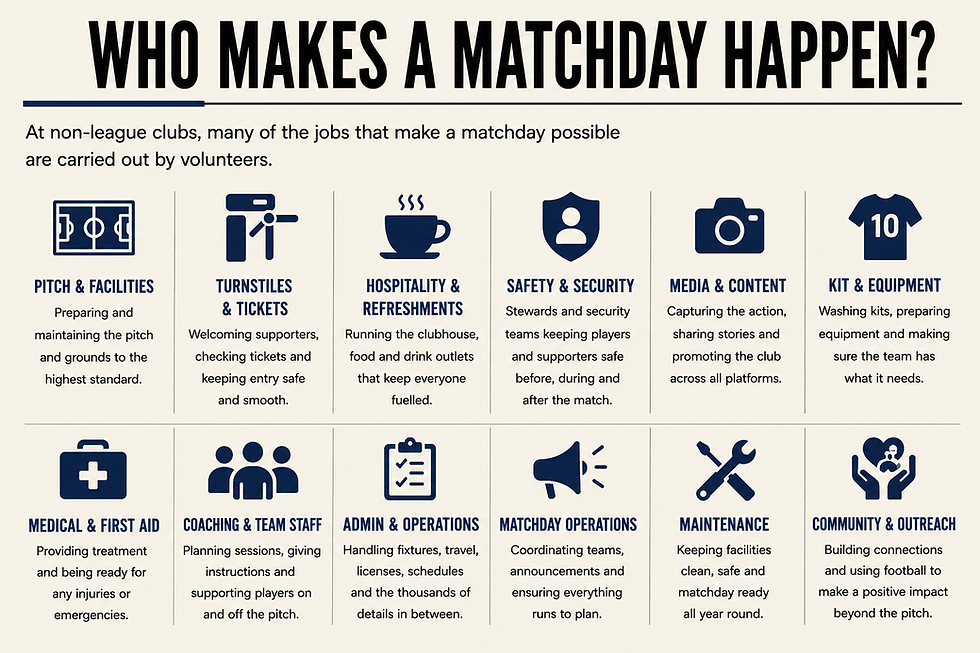
When a supporter comes to a football match, it would be easy for them to dismiss hospitality, car parks, turnstiles and kits as peripheral to the reason people go. None of these will directly alter the scoreline or determine whether a supporter goes home satisfied with the result. Fans could have a brilliant pie, but if their team goes on to lose, chances are they will forget about that pretty quickly.
But if you strip all of these features away and the people that help operate them for the fans, staging the match suddenly becomes a lot more difficult.
Mark Claypole, the club's Grounds and Maintenance Officer, became another familiar face during my time at Avro. I had a number of small conversations with Mark throughout my time at the club and, much like Malc and John, he was always incredibly welcoming whenever I was around the ground.
Ground maintenance is another job that can easily disappear into the background. Supporters arrive expecting a pitch to be playable and a stadium to be ready without necessarily considering the work required to get it there. It is only when something goes wrong, perhaps through bad weather or a postponement, that its importance suddenly becomes obvious.
Avro chairman Rob Currell has regularly stressed just how dependent clubs at this level are on the people willing to give up their time. Writing during Volunteers’ Week, Currell described volunteers as the “life blood of non-league football”, adding that clubs such as Avro rely on them to play an instrumental role in keeping their day-to-day operations running.
It is a reliance that extends far beyond simply helping out on a Saturday afternoon. In another tribute to the club’s volunteers, Currell said they “keep the wheels spinning” at grassroots clubs, with some of those at Avro having accumulated decades of service between them. That contribution does not necessarily require decades, either. When Avro advertised opportunities for people to get involved with the club, Currell argued that “volunteering a few hours a week makes a huge difference to a club like ours.”
“Volunteers are the life blood of non-league football.” — Rob Currell, Avro FC
Millions of hours for nothing
Research commissioned by the Football Association estimated that approximately 1.4 million people volunteer in grassroots football across England every year. Collectively, they contribute around 186 million hours annually. The average league or club official was estimated to dedicate around 12 hours each week to grassroots football, compared with approximately two hours for the average volunteer across other sectors.

These figures begin to demonstrate the sheer amount of unpaid work underpinning football below the professional game. At Avro, that extends well beyond matchdays. In 2024, the club launched a Volunteers Working Group which met at the Vestacare Stadium every Wednesday during the close of the season. The jobs advertised were hardly glamorous: gardening, painting, litter picking, cleaning and general DIY.
Two years later, ahead of Avro’s first campaign at Step Three, the club held another full-day volunteering event to improve its facilities. The work itself was hardly glamorous, with plenty of painting and restoration required to ensure the stadium was ready to accommodate an ever-growing fanbase. But the satisfaction of seeing those improvements, while bonding over a shared love for the club, helped make giving up an entire day worthwhile.
The irony is that as results improve on the pitch, operations off it have to grow too. Bigger crowds have to be accommodated, both among home supporters and away fans travelling to matches, meaning facilities need improving as expectations increase. Yet the people responsible for meeting many of those expectations can still be volunteers, not getting any pay.
The teacher running the media
One of the people I worked most closely with at Avro was Liam Bambridge. When he wasn’t working as a teacher, Bambridge had spent years giving up his free time to work within non-league football media, including eight years with Lewes before joining Avro. When I first met him, I discovered the time commitment involved before I had even properly settled into my role.
One of my first meetings with Bambridge came away at Lower Breck in November 2025, as Avro won 3-0 against the then league leaders on a cold, brisk Wednesday night, but the football represented only part of our evening. Bambridge pointed out to me that by the time the work was finished and everyone had travelled home, some of us would not be getting back until around two o’clock in the morning.
It was one of my earliest introductions to the reality of working behind the scenes in non-league football. A midweek fixture does not simply occupy the 90 minutes between kick-off and the final whistle. There is travelling, preparation and work afterwards, all while another career and ordinary life continue around it.
He regularly spoke to me about Avro’s need for more people within its media operation. There was simply too much work for one person to cover everything expected of a modern football club, whilst his own responsibilities demonstrated the problem at large.
On matchdays he operated as the stadium announcer, as well as conducting interviews with players and managers and working across the club’s wider media output. At the same time, he dedicated considerable time towards helping me improve my own work, offering assistance and feedback as I settled into my role.

He highlighted the contradiction facing those who work in non-league media, as most people doing the jobs were volunteers, yet what they were being asked to produce was often comparable to the demands placed upon people elsewhere in football. The platforms do not particularly care whether the person operating them is being paid. Supporters still expect team news, scores, photographs, interviews, video and reaction, all within a good time frame from the build-up to the game to just after the final whistle. A club’s social media feed does not stop needing content, and in a world where interactions are so important for growth, it cannot stop just because the person running it has other requirements.
My own role was primarily focused on giving greater publicity to Avro's women's, Under-18 and Under-21 sides. That meant producing graphics and result screens, writing match reports, conducting interviews and creating social media content around teams which could otherwise struggle for the same attention as the men's first team.
Bambridge regularly stressed to me the importance of attracting greater attention through social media and ultimately bringing more people through the turnstiles. If Avro wanted to continue growing as a club, increasing attendances was one of its biggest priorities away from the pitch. The work we were producing therefore had a purpose beyond simply keeping a social media account active.
The person posting an interview or operating camera equipment is not necessarily performing an optional extra. Their work can become part of how a club attempts to build its audience and its future.
When there aren't enough hands
As important as these people are, relying so heavily on volunteers presents its own problems. Clubs still need to find them in the first place, and then somehow convince them to keep giving up their time.
Avro's own attempts to do that demonstrate the scale of the challenge. In 2024, the club advertised for somebody to help recruit, support and retain volunteers across its different departments. The estimated commitment was around six hours every week, covering everything from bringing new people into the club to helping keep existing volunteers engaged.
There was one rather fitting catch: that role was voluntary too. It almost sums up the reality of operating a football club at this level. Volunteers had become so important that Avro needed another volunteer just to help look after them.
The problem was not restricted to finding people to manage volunteers. In April 2026, towards the end of my own time with the club, Avro advertised for a new Media Manager. Despite the responsibility that comes with managing the media output of a football club, that position was also voluntary.
It was not the first time Avro had looked towards volunteers to fill gaps within its media operation. The previous summer, the club advertised for a photographer, journalist and programme editor as it looked to increase and improve its output. All three roles were voluntary, albeit with reasonable expenses covered.
It reinforces what Bambridge had told me throughout my own time there. The demand for content was growing, but finding enough people with the time to produce it remained a challenge.
The difficulty is that goodwill cannot be treated as an unlimited resource. Jobs change, families require attention, and people's circumstances move on. Somebody willing to sacrifice every other Saturday today might not be able to make the same commitment next season.
For clubs relying upon those people across hospitality, media, coaching, maintenance and administration, losing even a handful can create gaps that are difficult to fill. The obvious solution would be employing somebody instead, but at a level where every additional expense matters, that is not always realistic.
It creates an unusual balancing act. Non-league clubs increasingly want to grow and operate more professionally, but much of that professionalism remains dependent upon people who are not professional employees at all.
After the final whistle
My own contributions at Avro were a small part of a much wider operation. It takes many hands to operate a matchday and ensure it runs as seamlessly as possible, with the ultimate aim of giving supporters the best experience surrounding the match.
On the bigger occasions, all of these responsibilities only become more obvious. The play-off semi-final against Lower Breck eventually finished with Avro celebrating a dramatic penalty shootout victory, but that moment was the culmination of considerably more work than the 120 minutes of football that had just taken place. Security staff had been needed, hospitality had been organised, the ground had been prepared, and several media teams had documented the occasion. Once the celebrations eventually died down and supporters began heading home, there was still work to be done.
It makes the term ‘volunteering’ feel slightly misleading. The term says very little about the role itself or the scale of the responsibility involved; it tells us only that somebody is giving up their time. Throughout my time at the club, I saw countless people give up evenings, weekends and hours for a football club they wanted to see succeed. Some had been doing it considerably longer than I had and would continue doing so long after my own role had finished.
The players will always receive most of the attention, and rightly so. They score the goals, win the matches and ultimately determine where Avro stands in the football pyramid. But if you remove the people responsible for the jobs that create that matchday experience, there suddenly might not be a match to watch at all.


Comments