

Fighting to be Noticed – The Battle for Attention in Non-League Football

Updated: Sep 4

Here’s one tip if you are a small football club looking for social media engagement. Win big and gain big. That’s what Avro did on the final day of the 2025/26 Northern Premier League West season, when it felt like every refresh of the official social media pages resulted in another graphic saying “Goal!”.
They went into the afternoon two points behind rivals Bury in an unlikely title race, needing to win against Darlaston Town and hoping the league leaders would slip up away at Atherton Collieries.
By half-time, Avro were 8-0 up.
By full-time, they won 13-0.
The scoreline completely obliterated Bury’s advantage on goal difference, meaning that even a draw wouldn’t be enough for them to win the title. However, the Shakers eventually won 3-0 to secure the title, meaning Avro’s impressive result ultimately counted for nought. Not if you were part of the social media team that covered the game, though. The day as a whole and the flattering result certainly gathered the attention of plenty of people online.
On X, Avro recorded more than one million impressions on the day alone, the highest single-day figure recorded during my six months working within the club’s media operation.
Unfortunately, that result was an outlier. Not everyone can win 13-0 each week.
There are 10,000 minutes in a week
10,080 if you want to be extra specific, meaning that 9,990 minutes do not contain the centrepiece of the club’s week: the game. The content during those 90 minutes comes from everything the players on the pitch produce. Goals, tackles, controversies, celebrations. It provides the perfect opportunity to write, video, photograph and talk about the game in front of you.

So what happens to the 99% of the week elsewhere?
My own role at Avro primarily involved generating greater publicity for the club’s women’s, Under-18 and Under-21 sides. I produced graphics, result screens, match reports, interviews and social media posts, often around teams which naturally received less attention than the men’s first team, presenting an obvious problem. You cannot create attention simply by demanding that people become interested.
With the men’s first team occupying the Saturday 3 o'clock spotlight, it left all the other Avro sides having to take centre stage on Sundays. Part of my role was ensuring those teams did not disappear from the club’s platforms during the rest of the week. This was easier said than done, as I couldn’t attend every fixture myself, meaning the quality of the coverage I could produce depended upon communication from somebody who was there, such as a coach. As a result, a photograph or video needed to reach me before I could turn it into something worth publicising. When communication was limited, so was my content.
It showed the wider difficulties of working voluntarily for these clubs, having to make sacrifices that meant not every hour was spent working on what you enjoyed doing. Not everyone can get to games to cover social media material, and even if they do, there is no guarantee that the content will be good and usable, especially compared to the quality of the main team. It highlighted one of the fundamental differences between clubs at this level and those in the professional game, who can send multiple photographers, videographers, social media producers, journalists and more to the same fixtures, provided the fixtures don’t clash.
Further down the pyramid, there might be someone waiting at home for somebody at the ground simply to let them know the score. But when I got good material, it showed through the socials.
My experience was far from unique. Corinthian-Casuals Head of Media Dominic Bliss has spoken about similar limitations, explaining that the depth of his club's matchday coverage can depend upon how many volunteers are available and whether the fixture is home or away.
Even something as simple as identifying a goalscorer can become difficult. Bliss described the frustration of publishing a goal update before discovering that the scorer was somebody else entirely. It is the kind of mistake that can look careless from the outside but demonstrates the difficulties of producing immediate coverage without the resources available higher up the pyramid.
At this level, the expectation remains instant. The information required to provide it does not always arrive quite so quickly.
Videos are key
In my experience, video was consistently the strongest material for interaction and engagement. It makes content easier for others to share with their friends or followers, promoting a constantly repeating cycle of clicks. During my time with the club, I would be begging for any sort of video capture to be able to post on stories, as that always seemed to perform the best not only in terms of likes but responses too.
One example came through Avro striker Harry Salt, who shared one of Avro’s posts containing footage of an Under-21 goal. It was only a small interaction but demonstrated another advantage clubs have online. Players are more likely to share content themselves, meaning it is no longer restricted to the audience already following the official club account.
To add to that, these players aren’t media-trained. They aren’t told to act a certain way on social media, or have their own PR person tweet for them, or only tweet when they score, for example. They are just normal people who use their accounts in the same way we do, to interact with others. The more interaction, the better.
For the likes of youth and women’s teams, this level of interaction can really make a difference. A supporter who primarily follows Avro’s first team might have little reason to care about the Under-18s, but put a goal directly onto their feed, and the barrier to engaging with them suddenly becomes a lot smaller.
Across the period in which I worked for them, the club's X account recorded 4.3 million impressions, an increase of 12%, alongside more than 100 new followers. On Instagram, Avro's videos accumulated over 150,000 views, with more than 1,500 likes and 200 new followers added during the same period. These figures all showcased the size of the audience available to a club playing outside the professional leagues.

Those engagements and followers are valuable, but for a club like Avro, the bigger challenge is turning digital attention into something tangible, whether that is greater attendance, stronger recognition or commercial value, and especially generating more money on matchdays. Seeing more people come through the turnstiles because they have previously engaged with the club’s social accounts was and still is the ultimate goal in the football market in this day and age for small clubs like Avro.
From a view to a turnstile
Avro’s average attendance rose to 284 in the 2025/26 campaign, 93 higher than the previous season. As much as it would be convenient to claim that social media was the reason for the increase, there was no way to prove that.

Avro were simultaneously enjoying an excellent season on the pitch, culminating in a last-day decider for the title, before eventually winning promotion via the play-offs. Winning football matches remains a fairly effective marketing strategy. Yet Liam Bambridge regularly stressed that increasing the club’s visibility online mattered because Avro ultimately needed more people coming through the turnstiles if it wanted to continue to grow.
The relationship between a social media impression and a paying supporter is far from straightforward. Like a lot of things on social media, people can scroll onto something, like it and refresh the page, and by that point the post has already become a forgotten memory. But another story from a different non-league club has demonstrated what can happen when online attention becomes a central part of its identity.
Telling the story
Farnham Town chairman Harry Hugo believes one of non-league football’s biggest missed opportunities is not necessarily what clubs achieve, but whether anybody hears about it.
Under Hugo, Farnham have placed digital storytelling at the centre of the club’s growth. Their Non-League Diaries give supporters gives supporters a regular behind-the-scenes look at the club, while short-form videos and social content ensure while short-form videos and social content ensure the story continues between matches rather than relying solely on results.
Supporters have travelled from places including Scotland and Manchester after discovering Farnham online. Hugo described social media as hugely important commercially and for both fan engagement and brand awareness.
“Other clubs achieve remarkable things too but struggle to get the message out and tell their story."
“With so many clubs farming for interactions, we knew we had to go to the extreme to rise above the rest in order to drive interaction with other fanbases. Targeting popular football personalities was something that people get easily attached to, and seeing them in other areas would move eyes, and more importantly for us, drive clicks.”
The strategy worked! Last year, former footballer Peter Crouch turned up to a game as the club’s mascot, driving social interaction through the roof, as big accounts such as Sky Sports and the BBC reported on the bizarre incident. The club managed to accumulate over 20 million impressions within the first 36 hours of the post going live, alongside a then-record attendance of 2,134.
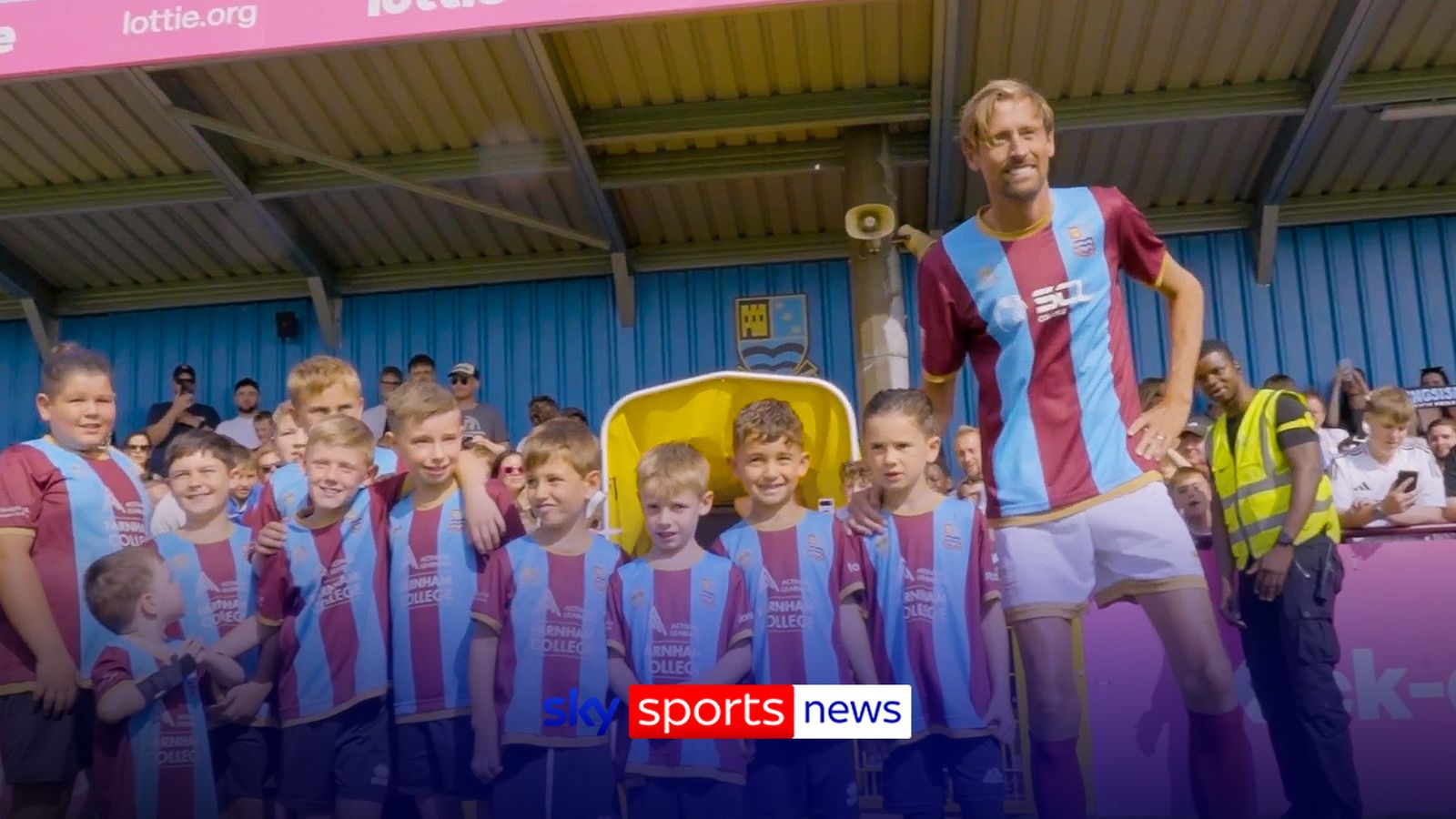
Of course, the stunt worked partly because of its absurdity. Peter Crouch turning up as a mascot stops being remarkable if it happens every week. The transferable lesson is not to find a former England striker, but to give supporters characters, stories and moments worth sharing so that Saturday's result becomes only one part of the club's identity.
A lot is made of maximising a non-league club’s local fanbase and encouraging supporters to attend on a Saturday afternoon, particularly for teams competing for attention with bigger clubs nearby. That is what makes creating an identity 24/7 so important, so that the result is only a small part of the ‘engagement’ week.
The responsibility of keeping a club visible online does not always have to fall solely on those working behind the scenes either. At Marine, supporters themselves have helped expand the club's presence beyond matchdays through independent fan media.
Marine supporter Adam Bretherton is part of The Crosender Way, a supporters' group which has produced YouTube vlogs, player interviews and podcasts surrounding the club. What started as an attempt to increase Marine's presence on social media developed into something with a wider aim of raising awareness of the club and attracting new supporters.
It offers another route for clubs without the resources of the professional game. Supporters are no longer restricted to consuming whatever the official account publishes; they can help tell the story themselves. For a club trying to remain relevant throughout the week, an active online fanbase effectively creates another media outlet without adding another person to the payroll.
When the audience comes first
Hashtag United started from the ground up, but they had a plan. Created by YouTuber Spencer Owen in 2016, they were an amateur football team that filmed and uploaded all of their videos online even before the club entered the English football pyramid. By the time they joined non-league football in 2018, they had more than 350,000 subscribers, a record high for a team that low in the football pyramid.
Commercial director Seb Carmichael-Brown said at the time that the club wanted to bring a “fresh set of eyeballs” into non-league football. It went completely against the typical curve of the game, essentially bringing people up to speed with what non-league football looked like from a casual perspective. It gave personality to the team and its players through highlights and extensive behind-the-scenes footage that showed players away from matches rather than solely through a camera filming the game from afar.

Their existence challenges the traditional idea of what a football supporter has to be. Somebody can follow a club as small and low down as Hashtag without living anywhere near the ground and never watching them live. They can know the players, interact with the team and others following it, and buy into the storyline Hashtag were trying to create all through a computer screen.
The circumstances are completely different for Avro, who cannot manufacture hundreds of thousands of followers, nor can social media recreate the generations of support enjoyed by clubs like Bury. Bury are themselves unusual at this level, carrying the history and support of a club that spent generations in the Football League before their collapse and subsequent return through the pyramid.
On the final day of the season, Avro were competing with Bury not just for the title but for attention too, having to make noise on a day that was crucial for both clubs. Scoring 13 goals certainly helped attract that attention, and even after the full-time whistle confirmed Bury as champions, Avro had still recorded their greatest day for social media views to date.
Attention has value
It’s all well and good nurturing a strong social media connection with supporters and ever-increasing views through posts and videos, but there is also another important element to growing a social media presence: the financial side. Promoting a strong social audience can help with advertising commercial opportunities to businesses. Its sponsorship material highlights a following of more than 12,500 people across social media alongside the physical exposure available at matches.
Sponsors are no longer paying solely for an advertising board on the side of a pitch that a few hundred supporters see. If this branding appears behind an interview, on a graphic, or through video content, it can potentially reach thousands more people who had no part to play inside the stadium.
This creates an interesting contradiction within the world of non-league football, as the media operations can contribute towards building an audience that clubs can subsequently offer to commercial partners, while much of the content itself is produced by volunteers working for free.
This trend is continuing into the new season for Avro, with the club advertising for a new Media Manager as late as this May, and stating its role as purely voluntary, despite dealing with a lot of financial technicalities and sponsor opportunities. The demand for media is greater than the resources and time many non-league clubs can afford to dedicate to it.
Fighting to be noticed
For all the millions of impressions accumulated during my time at Avro, most posts did not come remotely close to the attention generated by that 13-0 win over Darlaston. The reality was far more ordinary, with some graphics receiving a handful of likes, and occasionally a tweet or a video would do well and prove that there are people who care beyond the core audience.
That does not make the smaller posts pointless. A non-league club cannot rely upon extraordinary scorelines, former England players turning up as mascots or hundreds of thousands of subscribers to maintain attention. For clubs like Avro, it is about constantly finding something worth showing people during the long periods when there is no first-team match to provide it for them. Everything surrounding the first team has a place online and helps keep Avro visible.
That battle for attention is only becoming more difficult as football supporters are given more ways to consume games. Avro simply cannot compete with the Premier League for worldwide attention, nor can they rival the established support Bury carried into last season's title battle. What social media provides is an opportunity to remind people that the club is there and give them a reason to care about what’s next.
There are only 90 minutes of football on a typical Saturday afternoon, but another 9,990 minutes remain in the week. For clubs like Avro, fighting to be noticed means making those minutes matter too, whether that comes through a goal clip, an interview, a youth-team result or something as simple as reminding somebody that another game is just around the corner.


Comments