

Beyond the 92: What does it mean to be a semi-professional footballer?

Updated: Sep 4

To the naked eye, football is just a game. For many people growing up in the UK, chances are they will have kicked a football at some point in their life. Whether at school, college or the local park, or eventually at a match on the weekend, football can become part of everyday life.
But football in 2026 is much more than that. It is a business, a lifestyle, a career, a vocation and, for thousands of people, a destination. There is far more surrounding the game than simply a foot and a ball, much of which can go unnoticed by those unfamiliar with the industry. Winning is not just about the satisfaction of victory; results can influence sponsorship, revenue and the wider direction of a club.
At the top of English football, players can dedicate almost every waking hour to their profession. Where a Premier League footballer might spend the morning after a match focused entirely on recovery and treatment, thousands of players further down the English pyramid have something rather different waiting for them on Monday morning: another working week.
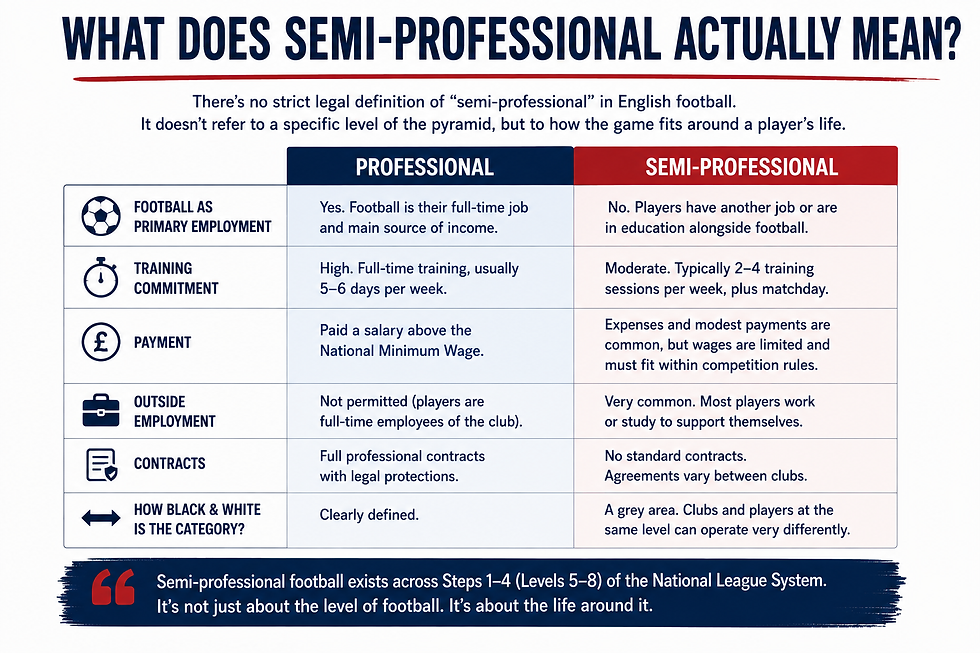
Semi-professional football is fundamentally the same game, but the wider picture surrounding it can look completely different. It is a world where training sessions take place after work; Tuesday night away games can follow an entire working day, while many of the people running clubs do so alongside careers and commitments of their own.
For six months, I experienced part of that world first-hand while working as a Media and Marketing Officer at Avro FC in Oldham. Founded in 1936 by workers at aircraft manufacturer A.V. Roe, Avro have undergone a remarkable rise through the football pyramid in recent years, reaching Step 3 for the first time in the club's history ahead of the 2026/27 season.
It was there that I began to understand just how blurred the boundary between professional and amateur football can become. The players are still paid, signed and released, managers can lose their jobs, and supporters still hand over money at the turnstile before grabbing their pie and Bovril. The fans can be every bit as passionate about players who aren't household names, except at this level, the player they're shouting at might actually know who they are.
Spend some time behind the scenes, however, and the differences become enormous. The office at Avro is effectively a shed in disguise, serving little purpose beyond providing somewhere to work and keeping you out of the cold on a winter afternoon. Nearby sits a function room and bar, where players can have a drink after the final whistle. There are no sprawling media centres or multimillion-pound training facilities; the football is the same, but almost everything surrounding it is different.
A pyramid much bigger than 92 clubs
The Premier League’s 20 clubs and 72 members of the English Football League make up what supporters traditionally call ‘the 92’, but relegation from League Two does not mean falling out of English football. Far from it.
For the 2026/27 season, the FA allocated 996 clubs across 48 divisions, 19 leagues and six steps of the National League System. The National League occupies Step 1, followed by National League North and South at Step 2. From there, the structure expands regionally until reaching 33 divisions across Steps 5 and 6.

It creates a pyramid containing vastly more clubs than the famous 92, yet many remain almost unknown beyond their local communities. Perhaps nowhere is the connection between those two footballing worlds more apparent than in the FA Cup, which offers clubs further down the pyramid the possibility of progressing far enough to face the professional elite.
Marine experienced exactly that when the Merseyside club reached the FA Cup third round in 2020/21 and were handed a home tie against Premier League side Tottenham Hotspur. There was only one fairly significant problem: nobody was allowed in. COVID-19 restrictions meant supporters were unable to attend Rossett Park, although a few lucky residents found themselves with arguably the best free seats in football as their gardens overlooked the ground.
Tottenham won 5-0, but the significance of the afternoon extended far beyond the scoreline. When I spoke to Marine vice-chairman Dave McMillan five years later, he said the fixture had been a “major factor” in increasing attendances after COVID and was “massive” in raising Marine’s profile.
“If you get to the third round of the cup and you’re live against Spurs, live on BBC One, then it’s not gonna do any harm in terms of boosting your profile.”
Dave McMillan, Marine vice-chairman, speaking to James Costello
The benefits were not restricted to publicity. “The Spurs game gave us the opportunity to reinvest that money in the club facilities,” McMillan said. That investment included installing a 3G pitch, refurbishing Marine’s social club and making further ground improvements, which later became increasingly important as the club climbed into National League North.
No wonder they call it the magic of the cup. But occasions like Marine against Tottenham are memorable precisely because they are exceptional. For some clubs, football is an occupation. For others, football has to fit around a different occupation.
Clocking off before kick-off
No two semi-professional footballers live exactly the same life. Some work full-time from Monday to Friday. Others are self-employed. Some study alongside playing. Whatever the arrangement, football has to coexist with responsibilities that simply do not exist in the same way for Premier League players.
Academic research often describes this combination of high-level sport alongside employment or education as a ‘dual career’. A 2026 systematic review of athletes combining sport with work found financial necessity was the most frequently reported reason for maintaining employment alongside an athletic career, while scheduling conflicts and physical and mental fatigue were among the barriers identified by athletes.
That can transform the most ordinary parts of a fixture list. A Tuesday night away match might follow an entire working day, while training cannot always be organised around optimum recovery when players have jobs to attend. Injuries can also affect more than availability on Saturday if a player's livelihood away from football depends upon them being physically fit. Where professionals can remain almost permanently engulfed within football's ecosystem, semi-professionals spend their lives bouncing in and out of it.
More than the starting XI
The players may put on the show, but a non-league matchday relies on far more than the starting XI. Someone needs to prepare the pitch, open the ground, operate the turnstiles, provide security, serve supporters and keep those following from home updated. Those jobs exist throughout football, but the major difference further down the pyramid is who carries them out.
At the professional level, many of those responsibilities belong to paid employees and dedicated departments. For smaller clubs, volunteers can be the difference between a matchday functioning and not functioning at all.
Perhaps nobody demonstrates the strange reality of non-league football better than Avro volunteer Malc Todd. An honorary life member, Todd has filled more roles at the club than most people will have jobs in their lifetime, serving as a kit man, first aider, car park steward, turnstile operator, junior referee, junior coach and vice-president. At a Premier League club, that list could represent half a department directory; at Avro, it represents one volunteer.
Former Avro head of media and communications Rob Currell described volunteers as the people who “keep the wheels spinning” at grassroots clubs, with some at Avro providing decades of service. The club’s volunteers have helped with everything from coaching and maintaining the ground to marketing, legal work and media.

Even Avro’s hospitality operation has an unlikely connection to football’s elite. After retiring, John Brereton began volunteering with the club’s matchday hospitality team, having previously worked in hospitality at Manchester City. It is the same sport and the same fundamental need to welcome supporters and guests on matchday, but a completely different environment in which to do it.
Without people like Todd and Brereton, clubs at this level would struggle to function in the way they do. Every supporter through the turnstile matters, as does every pint bought in the clubhouse, every local business willing to sponsor the team and every person prepared to give up their Saturday afternoon without expecting much, if anything, in return. The sums involved might be minuscule compared with those at the top of English football, but their importance can be enormous.
Football’s financial divide
Fundamentally, the same game is played for 90 minutes at every level of the pyramid. It is everything surrounding those 90 minutes that gives each layer its own distinct flavour. Broadcasting revenues shrink as you travel down the divisions, crowds become smaller, commercial opportunities become increasingly local and national media attention gradually disappears. Yet the objective remains exactly the same: win football matches and get promoted.
Concerns over football’s finances are not exclusive to semi-professional clubs. The government-commissioned Fan-Led Review of Football Governance examined the financial problems present throughout the pyramid and identified long-term financial sustainability as one of the fundamental issues facing the English game. It also highlighted the enormous financial gaps that can exist between different levels of the pyramid.
For a club such as Avro, which has experienced a dramatic upward trajectory in recent years, promotion represents success. The 2026/27 season sees the club competing at Step 3 for the first time, bringing different opponents, longer journeys and a higher level of competition. Climbing the pyramid can also bring changing demands surrounding grounds, operations and playing budgets, meaning that progression on the pitch has to be matched by progression away from it.
That creates an interesting contradiction within semi-professional football. Winning and climbing the pyramid is ultimately what every ambitious club wants, but what happens when that ambition begins to outgrow the resources available to sustain it? Success sounds universally positive on paper, but how much does it actually cost to keep progressing up the football ladder?
Fighting to be noticed
Money is not the only currency distributed unevenly across English football; attention is another. For clubs such as Avro, that attention often has to be created from scratch. Social media provides a way to keep supporters engaged beyond a few hours on a Saturday, while giving non-league clubs direct control over how they communicate through team news, graphics, interviews, match reports, photographs and live updates. It all sounds remarkably similar to the work being carried out by media departments across the professional game because, in many ways, the expectations are still the same. Supporters want immediate updates, photographs and highlights, while sponsors want exposure and clubs want people coming through the turnstiles.
The resources available to meet those expectations are very different. Having spent six months helping to produce that content myself, I saw how much work can sit behind something as simple as a team-sheet graphic appearing on somebody’s phone. At this level, media therefore becomes more than simply documenting what happens on the pitch. Visibility can help attract supporters, promote sponsors, showcase players and keep a club in the conversation for longer than 90 minutes on a Saturday. For clubs fighting for attention in crowded local sporting markets, being seen can become part of being sustainable.
A place to start again
Semi-professional football can also provide something less tangible than money or exposure: opportunity. For some players, dropping down the pyramid represents the latter stages of a career, whereas for others it can offer the chance to begin again.
Young players who don't make it through a professional academy can suddenly find themselves outside an environment that has structured much of their childhood. Non-league football provides another route, offering competitive matches, regular coaching and, most importantly, another opportunity to be seen.

Avro have their own examples of players progressing upwards after developing within the club. Their journeys demonstrate why non-league clubs cannot simply be considered smaller versions of professional ones. They can simultaneously operate as sporting institutions, workplaces, development pathways, community organisations and social hubs.
Part-time dreams with full-time needs
The English football pyramid is celebrated because, theoretically, every club has another rung of the ladder to climb. No matter how big or small the club, there is always another promotion or success to dream about, but every step of that pyramid needs people and resources to sustain it.
Part-Time Dreams with Full-Time Needs will explore the people who make semi-professional football possible: the players clocking off before kick-off, the volunteers and staff keeping clubs alive, the battle for attention away from the professional game and the young footballers using non-league as a pathway towards something bigger. Ultimately, it will ask whether the model underpinning this enormous part of English football is sustainable and, if not, what needs to change for it to become so. The dream of climbing the English football pyramid remains full-time, even when the resources rarely are.


Comments