

A Place to Start Again – Life After the Academy Dream

Updated: 7 days ago

One day, footballer Jordan Lussey was travelling on a private jet with Liverpool’s first team for a Europa League fixture against Besiktas in 2015. He was an unused option for Brendan Rodgers' side at the time, seemingly within touching distance of making a professional debut for the club he had grown up dreaming of representing.
That day sadly never came, as a few seasons later Lussey was spending three hours travelling to Blyth Spartans on a freezing Tuesday night. The stadiums had become smaller, the pitches less forgiving and the comforts of one of England’s biggest football clubs had disappeared. For a player who had been at Liverpool since the age of eight, it was an entirely different footballing world.
“You’re in a bubble at Kirkby. Being at Liverpool from the age of eight, it was all I knew,” he said.
Lussey, from Ormskirk, joined Liverpool’s academy in 2002 and remained there for more than a decade, progressing to the Under-21 side and representing England at youth level. The midfielder grew up surrounded by the facilities, expectations and identity of a club where his ultimate ambition, like so many others around him, was to become a professional footballer.
That bubble had unfortunately burst in 2015.

The odds of making the transition from academy prospect to established professional are remarkably small. The Premier League acknowledges that the majority of players will leave the academy system without a professional playing career. Among recent graduates, only 16% of those who started at Category One academies had made a league appearance. That figure falls to 9% for Category Two and just 5% for Category Three.

The figures suggest that being released is almost an inevitability for these young players, but the reality is much harsher than it may seem.
“The hardest part of leaving a major academy isn’t the drop in quality; it’s losing that built-in security blanket,” Lussey said. “When you’re young, they tell you you’re going to be the next Steven Gerrard, and as a kid, that is all you can think about. You go to school thinking about it, go to bed thinking about it; it becomes an unhealthy obsession for someone so young to think like that. Unfortunately for me, when the contract wasn’t renewed, the safety net that had formed had suddenly disappeared overnight.
“You have to learn how to survive in the real football world without the badge protecting you.”
Nowadays, the Premier League requires clubs to have transition strategies for released academy players, including a three-year commitment of support for those departing during the Professional Development Phase. That support can include education, career assistance and help with mental and emotional wellbeing.
Lussey had none of that at his disposal at the time.
“I didn’t have that kind of support when I was released. I had nothing to hold onto; I had to find my way out of the hole that was dug up for me all by myself.
“I couldn’t question why I was release. Meanwhile other players I had spent years with and formed good relationships with on and off the pitch were playing in the Football League, and I was stuck waiting for the phone to ring for an opportunity.
“I didn’t have the mental support to deal with that harsh reality. It took me to a dark place and I had to force myself to make peace with the path that I had gone down.
“I had to keep telling myself that my path was not over, that it had just gone in a different direction, and that was getting me by during a difficult time for me.”
That path took Lussey through numerous clubs outside the Football League, including Marine and Bootle, all with different surroundings and cultures, but the same football education he had received as a child didn’t simply disappear when he left Kirkby.

“I didn’t realise how massive the club was until I was on the outside looking in. The standards, the discipline, and the work ethic taught at Liverpool stay with you for life. Even at Bootle or Marine, I still held myself to those exact same high standards because that is how Liverpool had raised me.”
Finding a new route back
Dropping out of an academy environment does not always mean the professional pathway has disappeared completely. Tommy McDermott experienced his own difficulties when transitioning back into grassroots football as a teenager. Before eventually making his professional breakthrough, Avro provided somewhere for him to play and rediscover his enjoyment of the game.
“The biggest challenge I had at Avro was that initial step of coming back from academy football and playing grassroots again,” McDermott said.
“It was tough mentally, but with the players and staff we had, I started to enjoy my football again; it became a real team effort where we all pushed each other to work hard as we all wanted to win.”
His story subsequently travelled in the opposite direction to Lussey’s.
McDermott credits former Avro coach Wes Roberts with believing in him and working tirelessly on his development. Rather than treating his return to grassroots football as a reason to lower expectations, the club regularly moved him above his own age group when the opportunities became available.

“My time at Avro was everything to me, really. I had a coach that believed in me and worked with me tirelessly, and the club wasn’t afraid to move me up age groups at any chance they got.
“The connections I made at the club and the people I got to know ultimately resulted in me getting opportunities I wouldn’t have got if I was elsewhere,” McDermott said.
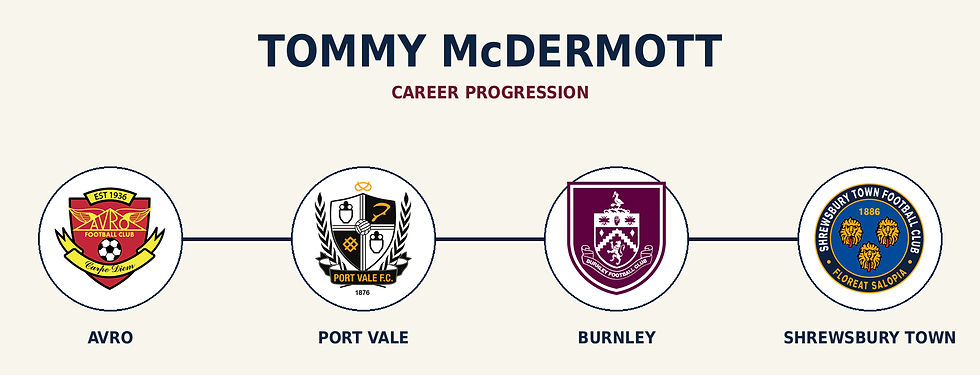
One of these opportunities eventually took McDermott into Port Vale’s youth system, where he made his senior debut for the club at the age of 17 before signing for Burnley. Last season, he gained regular Football League experience during a loan spell at Shrewsbury Town, playing 34 times and scoring once.
For a player who had once found returning to grassroots football mentally difficult, the step backwards had eventually helped him move forwards. When I interviewed him, I asked what advice he would give to young players in the same position he had once been in:
“The advice to the young talents there now is to really put the graft in, as Avro has a lot of eyes and people with connections at the club, and if you’re good enough, word gets about really quickly. There are people who have the capabilities to create opportunities for you at a professional level.”

There is no guarantee that following the same route will produce the same result, but McDermott’s journey demonstrates that leaving one pathway does not necessarily mean losing every route into professional football.
Building from the bottom
Not every football player goes from the top to the bottom before trying to rise back to where they came from. For some footballers, they start from ground zero and have to make the long journey up to professionalism.
That is the case for former Avro player Michael Afuye, for whom the club provided an introduction to semi-professional football rather than somewhere to rebuild after leaving the professional game. Afuye made his semi-professional debut for the club after joining in 2021. His pace and ability quickly established him within the side, but Avro resisted the temptation to rush his progression.

When he committed to another season in 2022, then-manager Alex Frost spoke publicly about the danger of talented players moving through the divisions too quickly, arguing that regular football without unnecessary pressure was more important for Afuye’s long-term development.
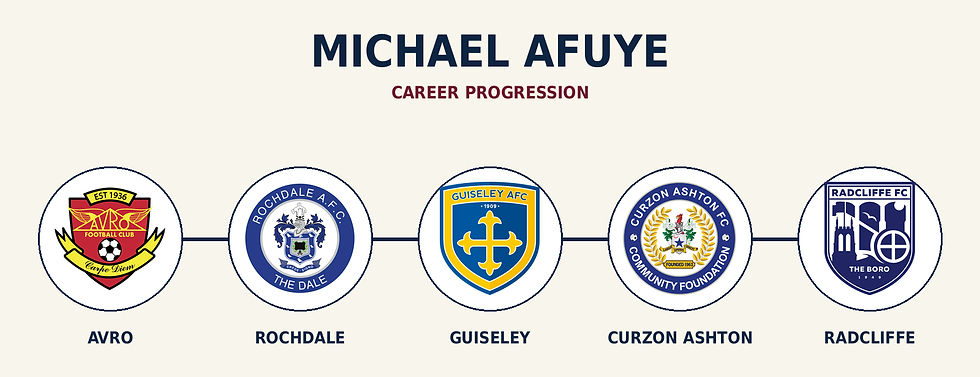
A year later, Afuye joined Rochdale, and since then, his career has taken him through Guiseley and Curzon Ashton before joining Radcliffe, where he continues to play in National League North.
“I look back on my time at Avro with happy memories, as I feel it gave me the foundations to be prepared for non-league football,” Afuye told me.
“I still speak to many people still involved with the club and try my best to get down to games. I was celebrating like a fan when we won that shootout to take us to the playoff final. I will forever be a fan because of the amazing time I had here.
“While playing for Avro, I met people who genuinely cared about me as a person, not just as a player, people that I could call friends for life, so I really appreciate my time there because along with good playing memories, I’ve met people who have had an impact on my life of which I’m grateful for.”

Afuye’s experience tells a different story that still results in a similar conclusion to McDermott’s, with both having used Avro as a pathway for further development before progressing higher up the football pyramid and taking what they learnt at the club with them. More importantly, it offers another interpretation of what player development can mean at this level.
It becomes easy to measure progression of players through transfers, appearances and the level that they play at. Afuye instead points towards the importance of the environment surrounding a young player and believes that was the crucial thing he took from his time with Avro.
“There’s a couple of interesting lessons I’ll carry with me for life so it’s hard to just pick one, but it would probably be the importance of having a good support system in place, having people that really care about you and are prepared to tell you the truth because at that level, it’s what’s needed."
For clubs without Premier League-level facilities, strong academy budgets or large teams of specialist coaches in every position, making the best environment possible out of what is available can be seen as one of the most valuable things a club like Avro can provide. It is not just about allowing a player to play the game, but providing somewhere they feel wanted and can continue to develop.
A place to start again
Football can be a cruel and incredibly harsh sport. Thousands of young players enter academy systems hoping to make football their career, but only a small proportion will eventually establish themselves in the professional game. For those who don't, there is no guarantee that dropping into non-league will eventually lead them back to a professional contract.
For every player spotted by a scout and offered another opportunity, countless others will build careers at this level or eventually leave competitive football altogether. However, that doesn't mean everything that came before was a failure.
Non-league football can provide competitive senior matches, different coach voices and environments where players are given the time and patience to develop, away from the intense expectations of a professional academy system. For some players, non-league football simply becomes their level. It is where they belong, and they are satisfied with that.

For others, it is just another step towards getting back to the top. For players who have spent much of their childhood believing there is only one version of a successful football career, perhaps simply discovering that another route exists can matter just as much. Every player’s journey is different, and very few take the easy, straightforward path.
Lussey has experienced both sides of that divide. After spending more than a decade developing within Liverpool's academy, his pathway took an unexpected turn into non-league football. The surroundings changed considerably, but the reason he continued playing did not. “People assume that dropping out of professional leagues means the dream is now over, but as long as you’re playing, football is a game of opinions. It only takes one performance in front of the right scout to turn things around.
“For me, the love for the game doesn’t change just because the stadiums get smaller; in the right environment, the love can increase.”


Comments